The Difference Between a Managed H2F Program and a Led One

Picture two Holistic Health and Fitness sites in the same division, funded off the same table, staffed to the same standard. Both have their billets filled, a billet being the funded position that a strength coach or dietitian or cognitive specialist sits in. Both run a clean dashboard. Attendance is tracked, sessions are logged, the monthly slides go up green. On paper the two programs are identical, and if you judged them the way the enterprise currently judges them, you would call both a success.
Then you walk the floor. At the first site, soldiers cycle through a facility that is busy and going nowhere. The specialists are present, the equipment is used, and twelve months later the formation moves the same weight, carries the same load, and lands on profile at the same rate it did before the program arrived. A profile is the medical restriction a soldier gets when the body breaks down, and it is the closest thing H2F has to a scoreboard. At the second site, staffed no better, the profiles are falling, the soldiers who used to fail the ruck are passing it, and the specialists talk about their work like it belongs to them. Same inputs. Same dashboard. Completely different program.
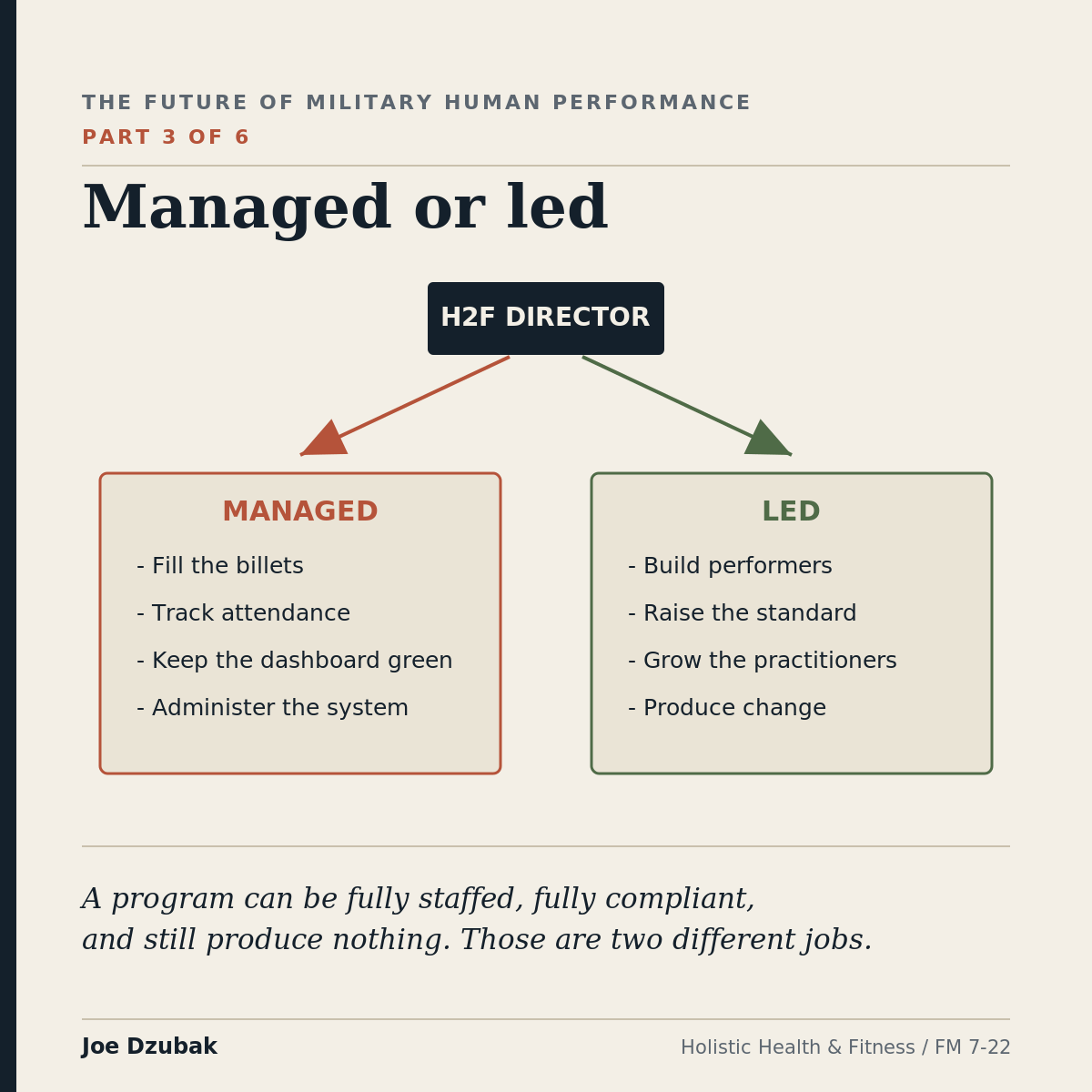
The gap between those two sites is not a science gap. Both have the same field manual, the same evidence base, the same access to FM 7-22. **The gap is a leadership gap, and it is the most expensive problem in H2F that nobody is measuring.** The first site is being managed. The second one is being led. Those are not two words for the same job, and the whole future of this program depends on the enterprise learning to tell them apart before the model hardens into its final shape.
Why leaders retreat to the countable
Start with the honest version, because the cynical version is wrong and it poisons everything downstream. The director running the hollow site is not lazy and is not a fraud. Put almost anyone in that chair, hand them the load that chair carries, and they will drift toward the same behavior. This is a structural outcome, not a character flaw, and if you treat it as a character flaw you will fire a good officer and the next one will do exactly the same thing.
Here is the load. An H2F director sits under a span of control, the number of people and functions one leader can actually hold in their head at once, that runs wide. Physical, nutritional, mental, sleep, spiritual, and the administration wrapped around all of it. Above them sits a chain that asks a specific set of questions on a specific cycle: Are the billets filled? Is attendance up? Are the numbers reported on time? Those are the questions that come with a suspense, a suspense being the hard deadline attached to a tasking, and they are the questions that get a director called into an office when the answer is wrong.
Now watch what a rational person does under that combination. When the administrative load is high and the incentive rewards the countable, the leader retreats to the countable. Not because they stopped caring about the soldiers, but because the countable is what protects them and the culture is what nobody is asking about. Filling a billet is a closed task with a clean finish. Building the conditions where a strength coach does the best work of their career is an open task with no finish line and no line on the slide. Under pressure, the closed task wins every time, and it wins for the same reason water runs downhill.
That mechanism is the whole problem, and it points at the real target. The previous piece in this series made the case that the incentive sits upstream of the behavior, that you get the performance you fund and the mediocrity you tolerate. Leadership is where that abstraction becomes a person. The director is not choosing headcount over culture because they are small. They are choosing it because headcount is what the system rewards them for, and no amount of exhortation to lead better will survive contact with an incentive that pays for something else.
What the research already settled
The distinction I am drawing has a literature behind it, and it is old enough that the argument is not whether it is true but whether we will act on it. John Kotter spent years separating management from leadership and landed on a clean split: management copes with complexity by administering the system that exists, and leadership copes with change by producing a new one. Planning, staffing, and tracking are management. Setting a direction, aligning people to it, and generating the motivation to get there are leadership. Both are necessary. A program with no management descends into chaos, and a program with no leadership stays exactly where it is, forever, no matter how clean the chaos it avoids. The hollow H2F site is fully managed and entirely unled, and Kotter would have called that outcome from the parking lot.
Bernard Bass took the next question, which is what each style actually produces in the people underneath it. Transactional leadership runs on exchange: meet the standard, get the reward, miss it, get the correction. It is management wearing a leader’s rank, and it reliably produces exactly the standard and not one inch more, because the deal on offer is compliance and compliance is what it buys. Transformational leadership raises the standard the follower sets for themselves, and Bass’s decades of data show it predicts effort and performance beyond the contract in a way the transactional style never does. A director who only tracks attendance is running a transaction. The soldiers and the specialists meet the number and stop, because the number is the whole ask.
Then there is the finding that turns culture from a slogan into a measurable input. Amy Edmondson’s work on psychological safety showed something that reads backwards until you sit with it: the higher-performing teams reported more errors, not fewer. Not because they were worse, but because they were safe enough to admit the errors, and the admission is what let them fix the mechanism instead of hiding it. Psychological safety is the shared belief that speaking up will not get you punished, and it is the precondition for every function H2F actually needs from its people. A strength coach who flags that the programming is failing a squad, a dietitian who tells the commander the fueling plan is not survivable in the field, a soldier who says the load is breaking them before it breaks them all the way: none of that reaches the leader unless the leader built the conditions where the truth is safe to say. **Psychological safety is not a comfort. It is the sensor package that tells a program where it is failing while there is still time to correct.** A leader who only manages headcount never installs that sensor, and then wonders why the dashboard is green and the results are not.
What the chair actually optimizes for
I have watched this from inside the work, and the practitioner’s read matches the research more closely than I expected it to. What a director optimizes for on a Tuesday is not the mission, it is the next question they are going to be asked. That is not cynicism, it is triage. When your inbox is full of suspenses tied to headcount and reporting, and none of them are tied to whether the culture is producing anything, you spend Tuesday on the suspenses. You would be irresponsible not to. The culture work is the thing you swear you will get to once the fires are out, and the fires are never out.
The culture that grows out of that is not neutral. It is a compliance culture, and a compliance culture has a specific texture you can feel the moment you walk in. The specialists do their prescribed contacts and clock the hours, because the hours are counted and the outcomes are not. The good ones, the coaches who came in on fire to actually change readiness, learn within a year that their extra effort shows up nowhere the system can see. So they ration it. Not all at once, and not because they went bad, but because effort that is never reflected back to you is effort you slowly stop spending. The formation gets the standard and nothing above it, which is precisely what Bass predicted a transaction would buy. Readiness is a system output, not a motivational state, and a system that rewards presence over production will output presence.
The hardest part to sit with is that everyone in that building can be doing their job correctly and the program can still produce nothing. The director filled the billets. The specialists ran the contacts. The dashboard is honest. Every individual box is checked, and the thing the boxes were supposed to add up to never arrives, because no one was ever held to the sum. That is the signature of a managed program that was never led, and you cannot fix it by working the boxes harder.
Reward the thing you actually want
If the incentive is upstream of the leader’s behavior, then fixing leadership means changing what the leader is measured and rewarded for. Exhortation is not a plan. Here is what a plan looks like, and every piece of it is meant to be counted.
Measure outcomes the leader can move, not activity the leader can log. Attendance and billet fill tell you the doors are open. They do not tell you the program works. Put profile rates, ruck and load-carriage performance, return-to-duty timelines, and reassessment deltas on the same slide as the headcount, and weight them heavier. The day a director’s evaluation turns on whether the formation got measurably harder to break, the Tuesday triage changes on its own, because now the outcome is the thing with the suspense on it.
Measure the culture directly, because it is measurable. Psychological safety has validated survey instruments with years of data behind them. Run one across the specialists and the supported units on a cycle, track the trend, and make a falling score a problem the director owns the way they own a missed report. A leader who knows the safety climate is scored will build the conditions that raise it, for the same rational reason they currently build the conditions that fill a billet. You get what you inspect.
Add retention and development of the specialists as a leadership metric. A director who burns through good coaches every eighteen months is failing at the exact job that does not show up on a headcount dashboard, because the billet stays technically filled while the talent bleeds out of it. Track voluntary departures, track whether specialists are growing into harder work or stalling, and treat a leader who keeps and grows their people as doing the thing the program most needs.
Then develop the skill instead of assuming the rank carries it. Leadership at the culture level is trainable, and right now we mostly promote clinical and coaching competence into a leadership chair and hope the rest appears. It does not appear on its own. Build the direction-setting, the alignment, and the safety-building into how H2F leaders are selected and grown, and stop being surprised when a brilliant clinician runs a hollow program.
None of this asks anyone to care more. The director at the hollow site already cares. It asks the enterprise to reward the work that actually builds readiness instead of the work that is merely easy to count, and to hold the leader to the sum of the boxes rather than the boxes themselves. Other branches are standing up their own versions of this program right now, watching how the Army does it, deciding what to copy. If the model they inherit measures a leader by billets filled and dashboards greened, that is the model that will calcify across the entire joint force, and it will be honest and green and produce a fraction of what it could. The window to set a different standard is open, and it closes the moment the first version hardens into the way it has always been done. Measure what you actually want, reward the leader who builds it, and the culture that a green dashboard has been hiding finally has a reason to exist.